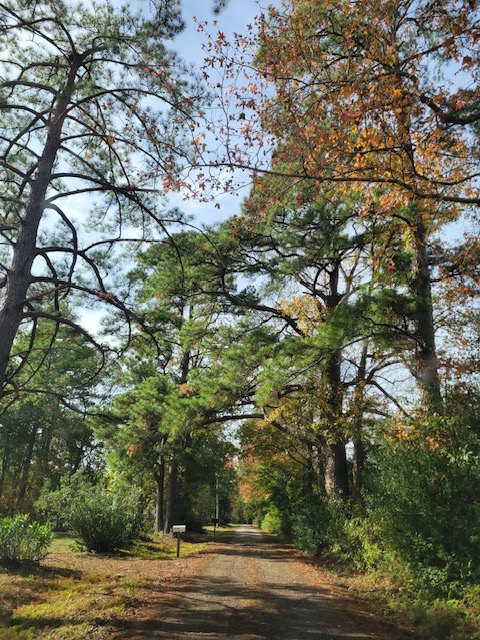

At the start of April, I took an early-morning walk in my neighborhood.
The first miracle
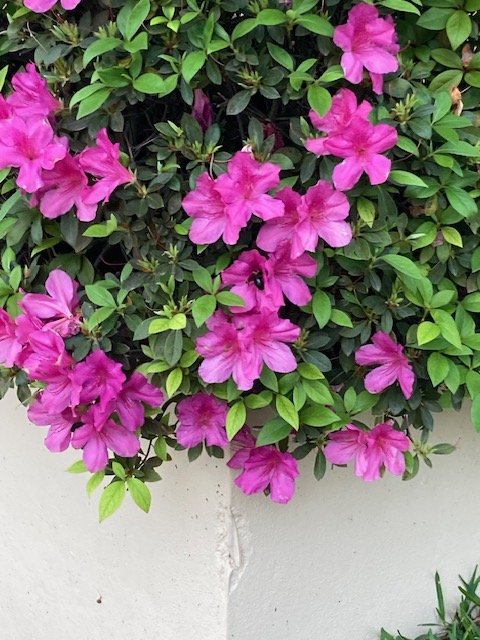
As I was just passing the second house, I had to slow down and step off the sidewalk to give some bees their space. You see, they were pollinating azaleas that were in bloom, right on the edge of the sidewalk.
That was the first miracle: Seeing bees in my Houston neighborhood!! I’ve walked in my neighborhood for almost 11 years. Despite all the gardens full of blooms I walk past every day, I rarely see bees, butterflies or other pollinators (more on that in a moment). So, this sighting felt already remarkable.
Childhood memories
But it gets more interesting: One of the two bees was a carpenter bee! And I knew it immediately by sight.
Can you spot the carpenter bee in my photo of the azaleas, below?
I love carpenter bees! I have lots of wonderful memories growing up with them in my childhood backyard, in San Diego. We would grow a whole wall of sweet peas every year. The sweet peas always drew several different species of bees to pollinate the blossoms, and I distinctly remember my mom pointing out the carpenter bees.
Although this year’s sweet peas have not yet reached the heights I remember from my childhood, nevertheless, you can get a sense of what a wonderful expanse of flowers they provide to bees:
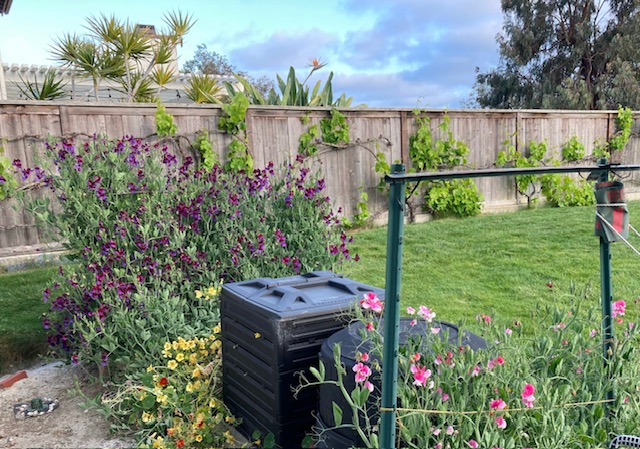
Photo credit: T. Leider
The other bee, in case you’re wondering, was a “regular” honeybee– but still a rare sighting in my neighborhood.
The plight of the bees
So, why are there so few pollinators in my neighborhood, despite all the lovely flowers?
I have a feeling it’s the same reason I rarely get mosquito bites when I take walks in my neighborhood. Yes, you read that right: Houston, aka Bayou City, has a few spots around the city where it’s possible to stroll outdoors and not get bit.
While this anomaly has been great for my mental health (in other words, to have the freedom to go outside and get fresh air whenever I need it), over time I’ve come to learn that there’s a dark side to being mosquito-free.
According to this comprehensive article on mosquito treatments from the National Wildlife Federation (NWF), “There is no way for companies to spray these broad-spectrum insecticides in your yard without also killing other insects they come in contact with, including bees, butterflies, caterpillars, ladybugs, dragonflies and other beneficial insects, along with the mosquitoes.”
Instead, the same NWF article offers directions for how you can treat mosquitoes more directly and safely:
Mosquito larvae need stagnant water to develop, so try to regularly remove or drain sources of standing water which can pool up in gutters, corrugated PVC drainage pipes, kids’ playsets or any debris left outside. For sources of water you can’t drain, use mosquito dunks or other products containing the bacterium Bacillus thuringiensis or “Bt,” which targets mosquito larvae and other biting flies but is essentially harmless to other wildlife and people. Other wildlife like turtles, copepods, frogs, dragonflies and birds are voracious predators of mosquitoes, so enlist their help by gardening for wildlife and doing your part to maintain healthy populations of these wild allies.
Especially as we draw closer to summer, and the mosquito treatment ads pop up, let’s protect wildlife. Keep our gardens humming. And in time, we may just witness the life abundant—not only for ourselves, but for all living things.
 Saving the Houston Piney Woods
Leave a comment