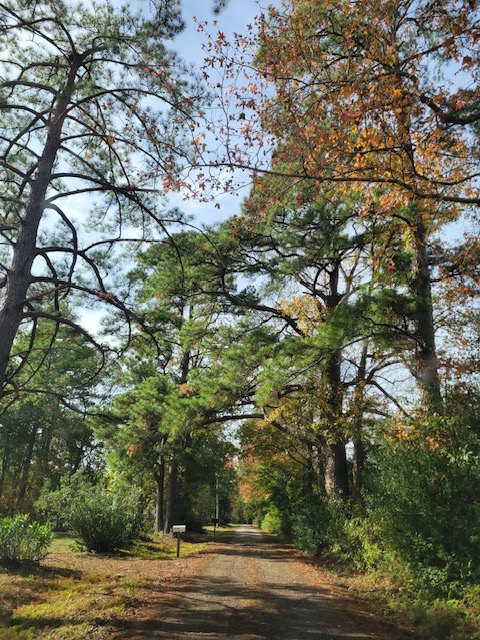
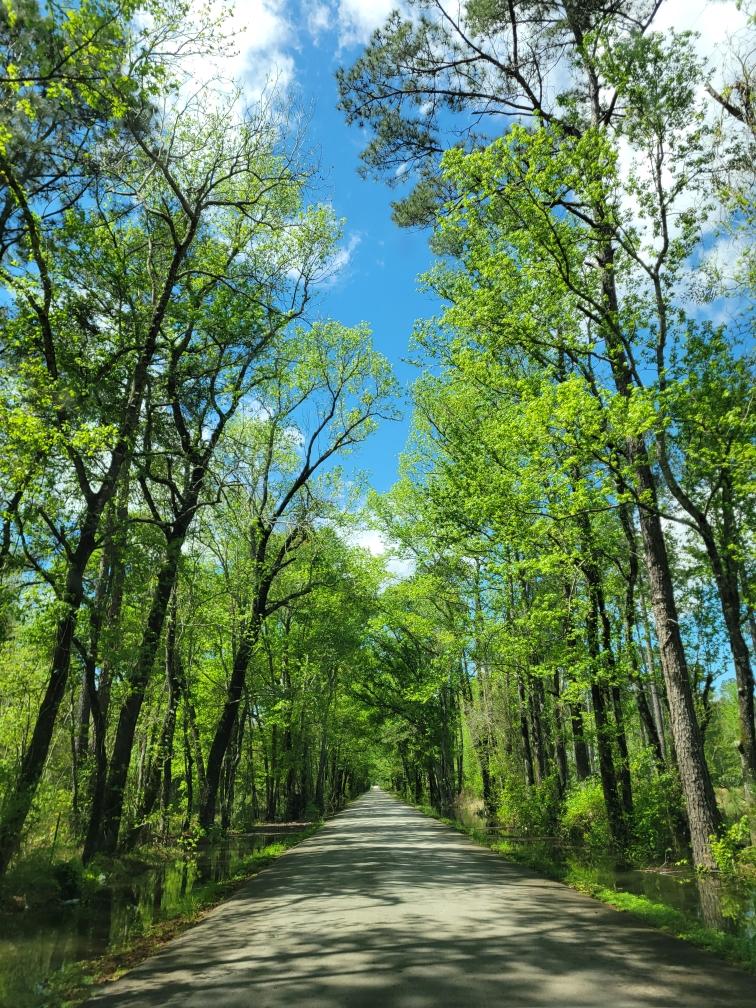
View of a Dayton, TX neighborhood, in 2024. Photo credit: W. K. C.
How did I find the Piney Woods?
It’s a personal story.
In 2023, after living a decade in Houston, I began hanging out with an acquaintance who lived near Dayton, TX (roughly an hour northeast of Houston). Although I knew semi-forested suburbs like Kingwood and New Caney fairly well, my friend’s neck of the woods turned out to be… literal. However, it seemed whenever I drove the US-90 route to visit them, that more acres of forest–all privately owned– were being developed every few weeks. I can’t tell you how much this hurt to witness, given my childhood life on the West Coast, where I was used to more restrictions put in place to protect land and wildlife. There was no sense of anyone preserving the Piney Woods for future generations to enjoy– not even to set aside a few acres for a small nature park.
I’m advocating for land that cannot speak for itself.
Then, in fall 2023, I began a technical writing certificate program offered at a local university, and the final research paper prompt challenged students to explore how technical communicators could advance justice in a particular field of work. I chose to write about what was at stake should the ecosystem comprising the Piney Woods be completely developed, and how technical writers can better advocate for the environment.
Justice is such a polarizing word!
Why use it?
What does it have to do with technical writing?
Although “justice” is often a polarizing, hotly-contested term in American culture in recent years (especially in Texas!), this paper prompt was intended to get students to think beyond tradition (“outside the box,” if you will). Technical writers have historically contributed invaluable support to government and corporate agendas, including the Nazis, in the name of “progress,” and/or to secure better income, so my professor emphasized the crucial need for ethical integrity in the field–that we should try to make things right in whatever work we do. Driven by my love for the Piney Woods, this meant taking a close look at the scientifically-proven benefits of intact forests, and scrutinizing the relentless urban sprawl that Houston is nationally (in)famous for.
What benefits do Texans lose if the sprawl wipes out the remaining Piney Woods?
While there are a few other plots points I haven’t shared regarding my journey to pursue environmental advocacy (namely, because that would mean a longer page!), the two stories above– visiting the Dayton area and writing the paper– remain the defining inspirations for beginning this blog.
I hope that you, and many others, will have a chance in the near future to visit the beautiful Piney Woods. Even more so, though, I hope Texans will join me and come together to protect this forest for the future.
Wanna visit?
Directions: The 59
To reach the Piney Woods, one way is to take the 59 northeast. Entering Kingwood, you’ll see the outskirts of remains of the forest. New Caney has been largely deforested at this point in many places, although you’ll still see pockets of thick forest by the freeway. However, continuing into Cleveland will show the thick, tall forest characterizing the Piney Woods.
Directions: US-90 E
However, as I also mentioned that I was visiting someone who lived near Dayton, so I typically drove to see them by taking the US-90 E, passing through the town of Crosby into Liberty County.
 Saving the Houston Piney Woods